

with experten Christian Stone form CPT (Concrete Preservation Technology Ltd)
Summary
A zinc anode produces roughly one volt against steel reinforcement — enough to permanently turn rebar into the cathode without any external power supply. In this episode, Christian Stone, Lead Material Scientist at CPT, explains why galvanic anode systems dominate in North America, the UK, and Australia, while the DACH region has built almost exclusively on impressed current cathodic protection (ICCP). The split, he argues, is about history and exposure conditions, not quality.
Why regions diverge on cathodic protection
Impressed current emerged in the 1950s and took off in the US through the 1970s and 80s. Galvanic anodes came later, researched largely at the University of Aston in the UK alongside companies like Fosroc, then spread through Canada, the US and UK. Standards were originally written for the constant current of ICCP; galvanic systems deliver a responsive, variable current that doesn’t fit cleanly into those frameworks. Countries with less coastline and less de-icing salt, like much of inland Germany, simply had fewer chloride problems and less reason to look elsewhere.
Australia shows the opposite case: nearly all its infrastructure sits on the coast, exposed to heavy marine chloride. Titanium ICCP anodes generate electrons by oxidizing water, producing oxygen and hydrogen ions – with enough chloride present, this manufactures hydrochloric acid that attacks mortar and concrete. Zinc corrodes without that acid formation. Regions with heavy de-icing salt use or marine exposure are consistently more receptive to galvanic and hybrid systems.
One is not necessarily intrinsically better than the other. They’re better in different environments, and they have different trade-offs, which in engineering terms is everything. — Christian Stone, CPT
How a galvanic anode actually works
Steel sitting in two differently aggressive environments naturally forms a battery: the more contaminated, active area becomes the anode and corrodes, while the passive area becomes the cathode and grows increasingly alkaline – a self-reinforcing, accelerating process. Attach zinc, roughly a volt more negative than steel, and the zinc takes over as the anode. It corrodes sacrificially while all the rebar becomes cathodic, builds its own alkalinity, and repels chloride and sulphate ions.
The current is inherently responsive: more moisture, more ions, or higher temperature lower the concrete’s resistance, and the anode automatically delivers more current — precisely when corrosion risk rises. No computer, no power grid, no manual tuning required.
Limitations and early mistakes with galvanic anodes
Zinc can become passive within certain pH ranges, largely through formation of calcium hydroxyzincate. Anode types from more than 30 years ago used lithium hydroxide to keep pH high and zinc active, but stock sitting in storage could partially carbonate before installation, arriving with reduced reserve capacity. Today’s anode chemistries, per Stone, are considerably more sophisticated, with feedback mechanisms against passivation and self-corrosion.
In highly resistive environments – latex-modified concrete, very dry masonry, terracotta facades over steel frames — the roughly one-volt driving voltage of zinc often isn’t enough. ICCP delivers more current here because there’s no voltage drop at a titanium anode consuming part of the energy.
- Marine and de-icing salt environments: galvanic anode territory
- Highly resistive media (terracotta, latex-modified concrete): favor impressed current
- Already very high, runaway corrosion rates: hybrid or ICCP needed
- High chloride but still moderate corrosion rate: galvanic often sufficient
The halo effect (or ring anode effect) around patch repairs
A standard patch repair removes the most contaminated concrete and replaces it with high-quality, alkaline repair material. Steel inside becomes passive and cathodic – but the still-contaminated, now micro-cracked concrete just outside the patch becomes the new anode and corrodes at an accelerating rate. That’s why areas surrounding patch repairs commonly start cracking again within three to five years, chasing problems across a structure one patch at a time.
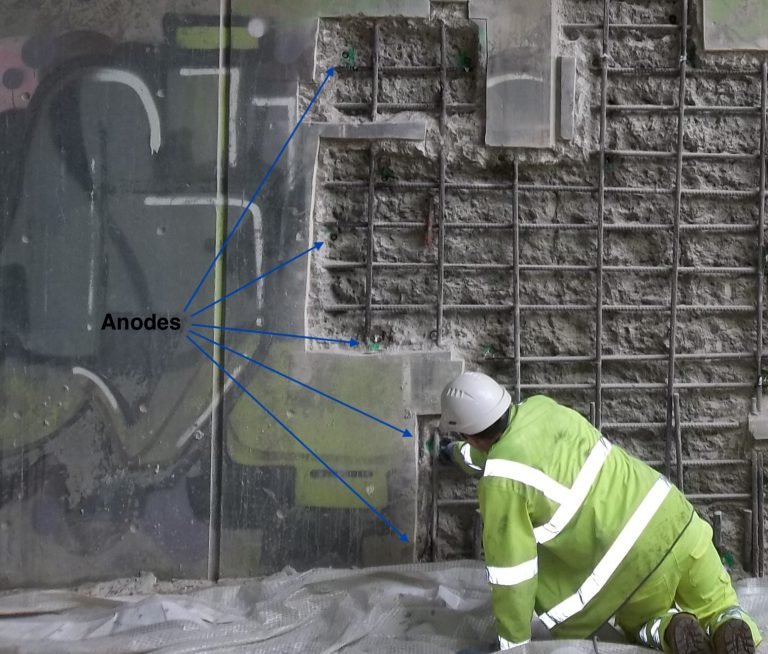
Zinc anodes placed around the repair perimeter force the adjacent steel to behave cathodically, effectively extending the protected zone by about 40 centimetres on each side without replacing additional concrete. Even once the zinc is consumed, the smoother alkalinity gradient it leaves behind reduces the sharp electrochemical discontinuity between old and new material.
You’re basically extending the size of your patch repair by about 40 centimetres on every side without having to pay for that concrete. – Christian Stone, CPT
Hybrid systems: strong start, low maintenance after
Hybrid systems, developed roughly 20 years ago, combine both approaches: powered temporarily like ICCP at the outset, then switched to permanent galvanic operation through the zinc anode. After about 50 kilocoulombs per square meter of steel surface, the steel environment’s pH shifts from around 7 to about 12.7 – a substantial re-alkalization achieved faster through zinc than through titanium, since no voltage drop at a titanium anode consumes part of the available energy.
Reference projects – White Adder Bridge in Scotland (carrying an A-road) and a pier on the River Thames – have run on hybrid anodes for about 20 years, monitored with manganese dioxide reference electrodes tracking steel potential, current, and polarization. During flood events, measured current jumps by roughly a factor of 20 almost instantly, correlating directly with local rainfall and tidal data. Maintenance across two decades: one SIM card replacement on the bridge, one battery swap every five years at the pier.
With galvanic and hybrid systems, they are self-regulating as long as they are properly designed and installed. – Christian Stone, CPT
FAQ
What's the difference between galvanic and impressed current cathodic protection?
Galvanic (sacrificial) zinc anodes generate their own protective voltage without any external power source and respond automatically to moisture and chloride content. Impressed current (ICCP) requires external power but delivers constant, adjustable current and a stronger initial effect.
How long does a galvanic anode last in concrete?
Christian Stone cites roughly 30 years as a typical design life for purely galvanic systems, up to 50 years for hybrid systems. ICCP is claimed at up to 70 years but requires ongoing maintenance and correctly maintained zoning to get there.
When should you choose impressed current or hybrid instead of a galvanic anode?
When corrosion rates are already very high and essentially runaway, in highly resistive materials like terracotta or latex-modified concrete, or when a fast, strong initial protective effect is required. In moderately contaminated or early-detected cases, a galvanic solution is often sufficient on its own.