
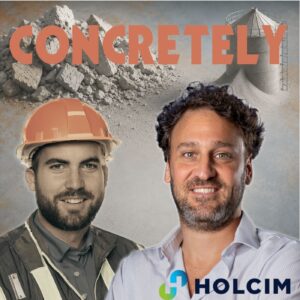
with expert Alfonso Paradinas Aguilera, CMO of the Holcim Group
Sustainable Concrete Durability: How Recycled Cement Paste Replaces Clinker
Cement accounts for roughly 8% of global CO2 emissions. Any serious conversation about sustainable concrete durability has to address how the industry cuts clinker content without compromising load-bearing capacity or service life. Alfonso Paradinas Aguilera, Global Chief Marketing & Innovation Officer at Holcim, joined Concretely to explain how his company is turning construction demolition materials (CDM) into a clinker substitute — not just a source of recycled aggregate.
Why fly ash and slag are running out
Fly ash and slag have been the industry’s default supplementary cementitious materials (SCMs) for decades, enabling the shift from CEM I to lower-carbon CEM II and CEM III systems. But Paradinas points to a structural problem: both are byproducts of fossil-fuel-dependent industries that are shrinking.
“Coal power plants and steel industry have been primary levers for clinker factor reduction… But there is a bottleneck, especially as coal power plants are facing out globally and steel production shifts away from blast furnaces towards newer and green steel architectures.”
To keep hitting clinker-reduction targets, Paradinas says the industry needs a new generation of SCMs from circular, widely available sources — construction demolition materials among them, alongside calcined clay.
From demolition rubble to clinker substitute
Paradinas defines CDM broadly: bricks, masonry, glass, excavation soils, asphalt, mineral wool. Most of this material is currently downcycled — used cheaply as road-bed fill.
Holcim’s alternative runs through what it calls circular hubs, located near “urban mines” — cities as the raw material source. The process:
- Collection and sorting of demolition and excavation material on- or off-site
- Crushing via a proprietary “smart crushing” process that Paradinas says gently separates cement paste from the aggregate, rather than fracturing both together as conventional jaw or impact crushers do
- Separation into coarse/fine aggregate (roughly 80% of the concrete mass) and cement paste fines (roughly 20%)
- Screening of the cement-enriched fine fraction (0.25mm down to 125 microns)
“This high-tech crushing device, it massages the rocks… allowing for that cement paste to be released from the rock itself.”
The result, according to Paradinas: lower water absorption in the recycled aggregate and a packing density that rivals virgin stone quality.
Carbonation as a carbon sink
The cement-rich fines are then either thermally activated in the clinker kiln or treated through carbonation using the kiln’s own hot flue gases — turning a waste stream into a double win.
> “The cement finds are basically sponges… they literally capture the CO2 and permanently stores it. So the fact that what you have is an SCM that can replace clinker, but at the same time is a carbon sink.”
Chemically, calcium hydroxide and calcium silicate hydrate in the old cement paste react with CO2 to form stable calcium carbonate and reactive silica gel. That yields a substitute for clinker — the most expensive input in cement manufacturing — and a permanent CO2 sink at the same time. Holcim is targeting a 65% reduction in clinker factor by 2030; Paradinas says CEM I already accounts for less than 10% of Holcim’s European cement sales.
Does it hold up for exposed structures?
For infrastructure exposed to freeze-thaw cycling, carbonation, and chloride ingress, the real question is whether low-clinker cement performs over decades of service. Paradinas names the typical engineering concerns directly: carbonation resistance, faster portlandite depletion, reduced pH buffering, early strength development, workability retention.
His answer: move away from prescriptive minimum cement content toward performance-based criteria — pairing specified carbonation resistance with corresponding concrete cover depth, disciplined curing, real-time monitoring (Holcim uses tools called SmartCast and SmartTherm), and standardized depth-of-carbonation testing for quality control.
“Our low carbon cements, they behave from a structural standpoint, from a carbonation resistance, from an early strength development, from a workability retention standpoint, equally, if not better than the traditional CEM1.”
Holcim’s EcoPlanet line — defined as at least 30% below the average CO2 footprint of cement in a given market — is, per Paradinas, already routinely specified in infrastructure, residential, and industrial projects.
Standards are catching up
Asked whether standards exist yet to support performance-based specification, Paradinas cites concrete regulatory progress in Europe: EN 1975 for multi-component low-clinker formulations, EN 1976, which permits up to 35% recycled concrete fines in cement, and the EU Circular Economy Act along with the revised Waste Framework Directive.
“The EU ETS officially recognized carbon mineralization into products as a permanent carbon removal lever.”
Zurich as the reference case
The clearest example in the conversation is the City of Zurich, which requires both a CO2 reduction and a minimum recycled-content share — 25 to 30%, according to Paradinas — for public procurement.
“We do have Zurich as our North Star.”
Holcim now operates 109 local circular hubs near major metropolitan areas and has acquired ten recycling companies across the UK, Belgium, France, Germany, and Switzerland over the past three years, with EBIT margins Paradinas describes as exceeding 30% in some cases.
UHPFRC and carbon-prestressed concrete
Beyond low-clinker standard cement, Holcim also offers high-performance materials such as Ductal (UHPFRC) and a proprietary product called CPC (carbon prestressed concrete), which embeds prestressed carbon fiber cables instead of steel reinforcement.
“There’s no corrosion. You can have very, very thin slabs.”
Paradinas says Holcim has sold five prefabricated bridges using this technology this year; it was originally developed at the University of St. Gallen.
Takeaway
Paradinas closes with a four-point call to action: replace prescriptive minimum clinker content with performance-based durability specs, mandate minimum recycled content (10-30%) in procurement, require digitally verified EPDs at the bidding stage, and bring innovation teams into structural design early. And, without any marketing gloss: “I’m a concrete lover.”
FAQ
What is recycled cement paste and how is it different from standard concrete recycling?
Conventional concrete recycling mostly reuses the aggregate (sand, gravel). Recycled cement paste refers specifically to the fine, cement-rich fraction (0.25mm to 125 microns) extracted from demolished concrete, which is thermally activated or carbonated and used as a clinker substitute in new cement.
Is low-clinker cement suitable for exposed concrete structures like bridges?
According to Alfonso Paradinas, yes — Holcim’s EcoPlanet cements are already specified in infrastructure projects, provided performance-based criteria such as carbonation resistance and concrete cover depth replace rigid minimum clinker requirements.
How does carbonation contribute to sustainable concrete?
Carbonation is used to permanently bind CO2 from kiln flue gases into the recycled cement fines. This simultaneously produces a reactive clinker substitute and a permanent carbon sink.
Links
- [UHPFRC with Prof. Brühwiler]
- [Concrete monitoring — detecting rebar corrosion]
- [CO2-reduced cement and sensor technology]
- Holcim – Urban Cities
- Holcim – EcoCycle