
How modern Concrete Inspection like GPR, Ultrasound & AI is used to inspect structures efficiently and enables databased maintenance.
with expert Koichi Oba, CEO of Proceq (Tectus Group)
Summary
Concrete Inspection: Why Modern Testing Methods Are Critical
Concrete inspection is becoming a key discipline in infrastructure inspection and non-destructive testing of concrete structures. Engineers and asset owners rely on technologies such as GPR and ultrasound to assess structural condition. Many bridges, parking structures, and industrial assets are reaching an age where visual inspection alone is no longer sufficient. Modern non-destructive testing methods such as GPR, ultrasound, and impact echo enable a much deeper understanding of structural condition and risks.
Concrete Inspection with GPR, Ultrasound and Impact Echo
Concrete inspection is not based on a single method, but on the combination of multiple technologies. Each method has specific strengths, and only their interaction enables a reliable condition assessment of reinforced concrete structures.
What is measured with Eddy Current in concrete inspection?
The eddy current method is used for highly precise determination of concrete cover and for locating reinforcement close to the surface. It is particularly suitable for accurately detecting near-surface rebar.
What is GPR (radar) in concrete inspection?
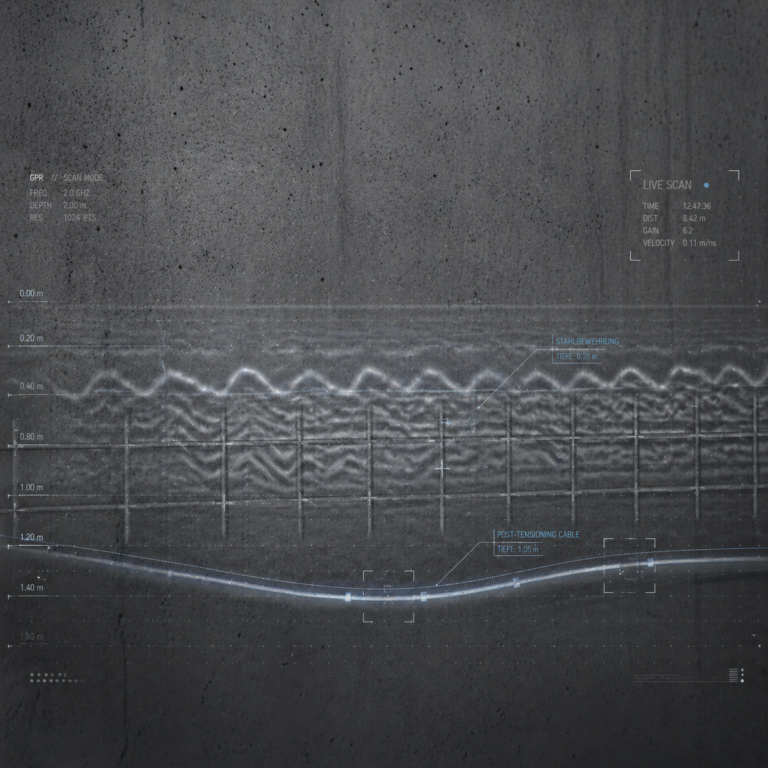
Ground Penetrating Radar (GPR) is a non-destructive testing method used to detect reinforcement, post-tension cables, and internal structures within concrete. It enables fast inspection of large areas and provides a good overall overview of the structure’s condition.
When is ultrasound used?
Ultrasound is used for detailed investigation of internal defects such as voids, cracks, or delamination. It penetrates deeper into the concrete compared to other methods. However, its application is more complex than GPR and is typically performed locally when more detailed information about material integrity is required.
What is Impact Echo used for?
Impact Echo is used to identify delamination and near-surface defects in concrete. It complements other methods by detecting areas with poor bonding or internal damage.
What is the Schmidt Hammer used for in concrete inspection?
The Schmidt Hammer (rebound hammer) is used for quick and non-destructive estimation of the surface strength of concrete. By measuring the rebound value, conclusions can be drawn about compressive strength and material uniformity. The method is particularly suitable for preliminary assessments and comparative measurements over large areas, but it does not provide direct information about the internal strength of the structure and should therefore be complemented by other testing methods.
Why is the combination of methods important?
No single method provides a complete picture. The greatest value lies in combining GPR, ultrasound, Impact Echo, and eddy current to achieve a well-founded and reliable diagnosis of the structure.
What is the Potential Field or Half-Cell measurement?
The potential field measurement, also known as the half-cell method, is used to assess the probability of corrosion in reinforcement within concrete. See our separate article and podcast episode with Aldo Rancati here.
Unlike the methods described above, this technique does not focus on geometry or defect detection, but on electrochemical activity related to corrosion. It is typically used as a complementary method for more in-depth analysis.
Comparison Table of Non-Destructive Technologies for Concrete Inspection
| Method | Effective Depth Range | Accuracy / Resolution | Main Applications | Strengths | Limitations |
|---|
| Eddy Current | 0–100 mm | Very high (±1–3 mm cover) | Rebar cover, position, diameter (limited) | High precision near surface | Limited depth, interference in dense reinforcement |
| GPR (Radar) | 0–300 / 500 mm | Medium (frequency dependent) | Rebar layers, post-tension cables, ducts | Fast, large-area scanning | No direct diameter measurement, interpretation needed |
| Ultrasound | 0–>1000 mm (point-wise) | Medium to high (local) | Voids, defects, non-grouted areas | Deep penetration, good for material condition | Slow, not suitable for large-area scanning |
| Impact Echo | 0–500 / 800 mm | Medium | Delamination, voids, thickness | Effective for slabs and bridge decks | Requires experience for interpretation |
Non-Destructive Testing Workflow: A Systematic Approach
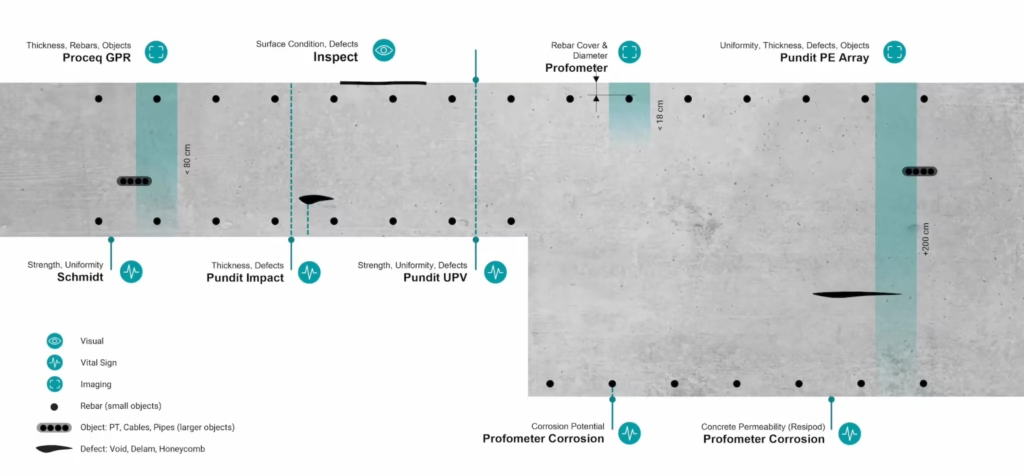
According to industry practice, concrete inspection follows a structured workflow that combines different methods depending on the objective:
- Visual inspection and AI-based crack detection
- Impact echo for early detection of delamination and voids
- Ultrasound for targeted investigation of internal defects
- Eddy current for precise rebar positioning and cover
- GPR for large-scale scanning of reinforcement and deeper structures
- Potential Field Measurement
This approach follows the principle of moving from fast screening to targeted analysis.
Concrete Inspection of Post-Tensioned Structures
A particularly critical application of concrete inspection is the assessment of post-tensioned bridges. Many of these structures were built after World War II using prestressing techniques to reduce material usage and increase span length. Over time, non-grouted ducts and corrosion of tendons can lead to serious structural risks.
In practice, inspection often follows a structured sequence:
- GPR scanning to identify critical zones and locate tendons
- Ultrasound testing for detailed verification of voids or defects
- Targeted drilling and endoscopic inspection
- Repair through corrosion protection and grouting
This multi-step approach allows efficient screening while focusing detailed investigations only where needed.
Concrete Inspection with Cloud, AI and Automated Reporting
One of the biggest challenges in concrete inspection is not the measurement itself, but the interpretation and reporting of data. Traditionally, engineers work with multiple tools, software systems, and manual reports. Modern solutions integrate inspection data into cloud-based platforms, enabling real-time visualization, automated analysis, and standardized reporting.
AI plays a key role, for example in automatically detecting cracks or counting rebars from GPR data. With integrated systems, engineers can generate reports at the push of a button, significantly increasing efficiency and consistency.
Concrete Inspection Challenges: Aging Infrastructure and Lack of Experts
Concrete inspection is facing a structural challenge: the number of aging assets is increasing rapidly, while experienced inspectors are retiring. At the same time, the complexity of structures and the volume of required inspections are growing.
This creates a strong need for:
- standardized inspection workflows
- intuitive data visualization
- AI-supported interpretation
- scalable inspection solutions
Without these improvements, maintaining infrastructure at scale will become increasingly difficult.
Concrete Inspection in the Future: Digital and Data-Driven
The future of concrete inspection lies in the integration of testing methods with digital technologies. Vehicle-mounted GPR systems already enable scanning of bridge decks without traffic interruption. Robotics, drones, and 3D scanning will further increase efficiency and safety.
In the long term, inspection data will be integrated into digital building models, point clouds, and asset management systems. This creates a “digital history” of a structure, allowing engineers to track past inspections, repairs, and structural changes over time.